
Howie the Howitzer
Spring Training Is a Time for Unknown Sluggers to Make Some Noise

The baseball calendar has turned to spring, and the rituals of the game are again unwinding on the sunny fields of Florida and Arizona. One of those abiding truths of spring baseball is that anything can happen. It’s a time when the unknown kid with thunder in his bat can come from nowhere and make the big leagues.
That’s certainly what Howie Moss hoped that January in 1942. The 23-year-old had torn up the minors the previous season, hitting more than 30 home runs, while batting better than .340. He and his employer, the New York Giants, had a rocky past. A contract squabble got him branded as an “outlaw” and tossed out of baseball for a while. Moss was sure, though, that his bat couldn’t be ignored, that it would get him to training camp, which was to start in a month.
He was sure of that until Dec. 7. Everything changed after Pearl Harbor. No one was certain a month later that there would even be a baseball season. Moss had to fear that his career would become one more casualty of war.
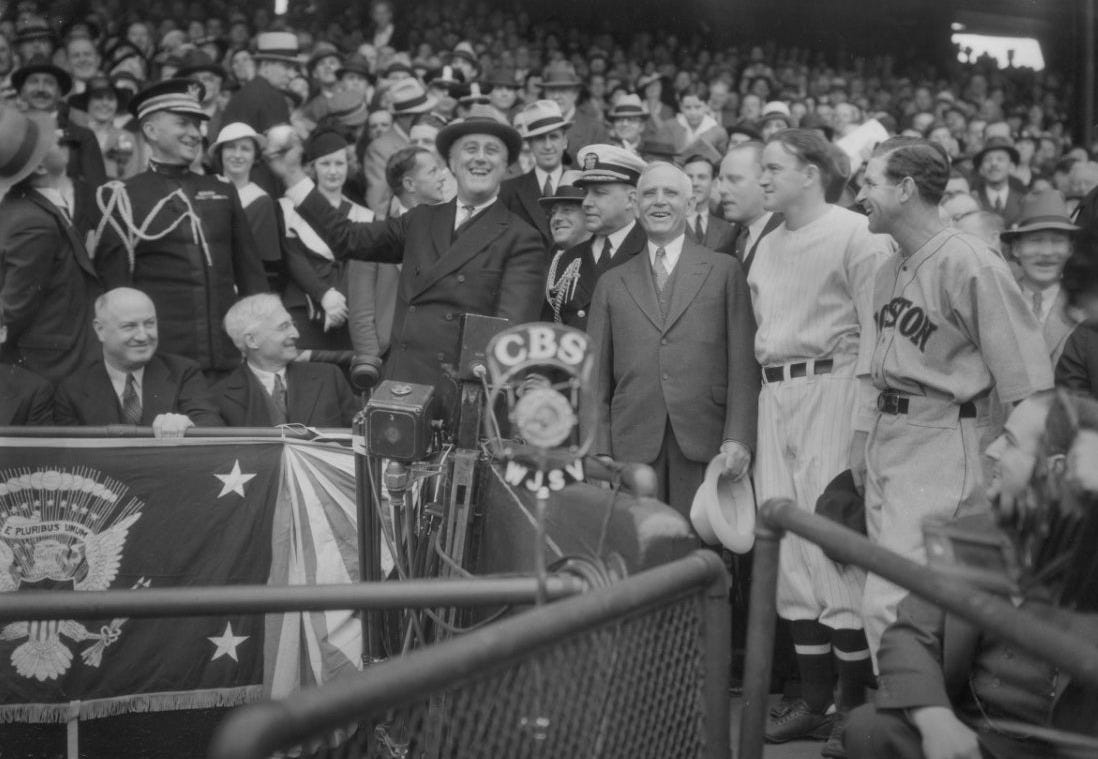
The man in the White House, though, was a baseball fan. Franklin Roosevelt had played it as a kid and managed the team at Harvard. He would set a record by throwing out the first pitch at eight Opening Days. FDR recognized baseball’s wide appeal and the value it would bring to a nation during perilous times. The season should proceed, the president wrote in a January letter to Kenasaw Landis, the baseball commissioner. “I honestly feel that it would be best for the country to keep baseball going,” FDR wrote in what is now known as the Green Light Letter. “There will be fewer people unemployed and everybody will work longer hours and harder than ever before. And that means that they ought to have a chance for recreation and for taking their minds off their work even more than before.”
Within a week, a relieved Moss received the telegram at his home in Gastonia ordering him to the Giants’ camp in Miami, FL. Despite his past beefs with the team and before the draft reached him, the kid they would later call The Howitzer would get his shot.
Legion Champ
Born in 1918, Howard Glenn Moss was the youngest of Elga and Laura’s three sons. Both worked in local textile mills. He starred on the baseball teams at Gastonia High School and at American Legion Post 23. Moss pitched and played third base in 1935 for the post team that won the legion’s national championship. He hit .692 during the series.
A senior that year, he received scholarship offers from several Southeast colleges but chose a paying job in the middle of the Depression. He signed with the Giants, who shipped him to their Class C club in Greenwood, Mississippi, paying him $150 a month, or the equivalent of about $3,200 in current dollars. “People were making $12 ($21) a week back home, so it wasn’t as bad as it sounds,” Moss said years later. “Besides, I never thought of doing anything for a living but playing baseball.”
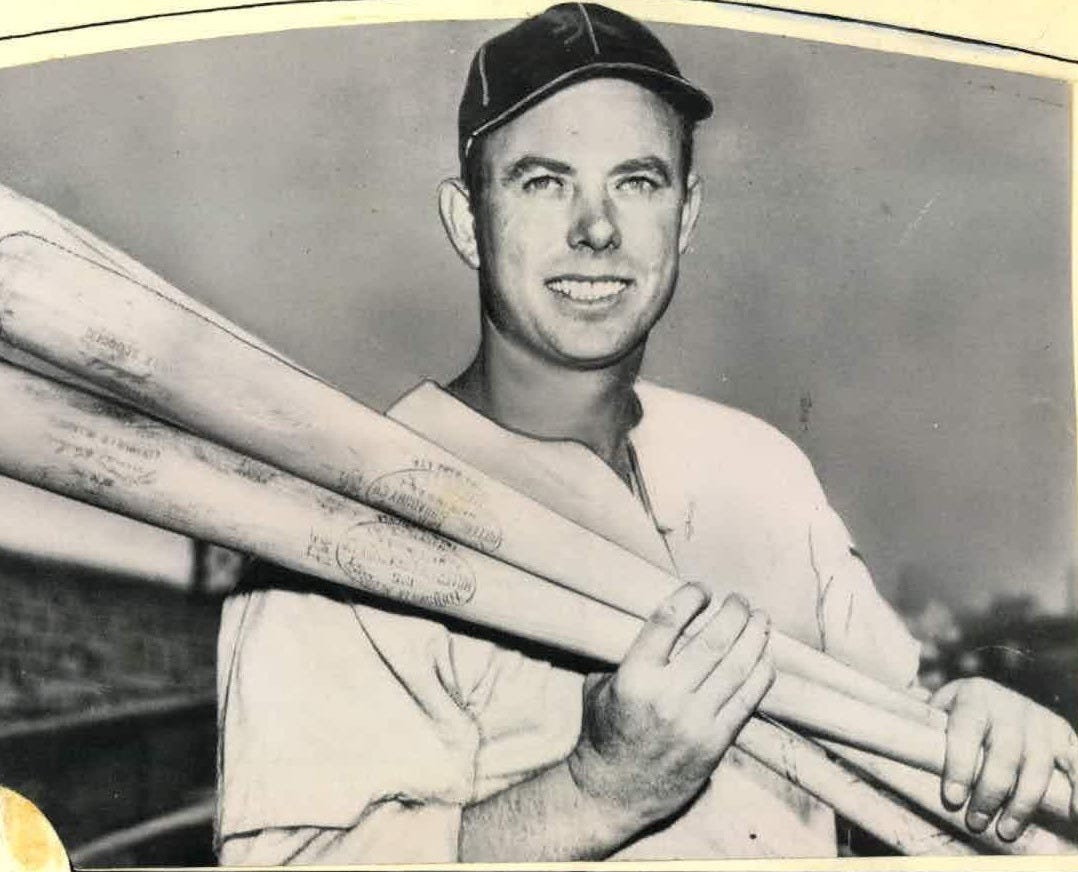
The Greenwood Chiefs introduced the 17-year-old to life in the minors, where he would spend most of the next 16 years. The antiquated school bus that ferried the team to the towns in the Cotton States League often broke down on lonely stretches of road in Mississippi, Arkansas, or Louisiana. The springs in its worn seats transformed into painful spikes with every bump. Once, a pitcher with more fastball than sense jumped into a muddy, raging Mississippi River to win a $5 bet. Manager Frank Brazill ordered him fished out because he couldn’t afford to lose that day’s starter.
Moss hit .233 with one home run that season, underwhelming numbers that certainly affected the new contract the Giants sent him that winter. He didn’t like those numbers, but there was little he could do about them. Like all pro players, his original contract tied him the signing team for as long as he played professional ball. If he didn’t like the offered salary, all he could do was stay home. Which is what he did. A new team sponsored by one of the local textile mills quickly snapped him up.
The Outlaw Howie Moss
The Gastonia Spinners was one of the eight teams sponsored by the mills in the independent Carolina League, which had started play in 1936.1 The industrial leagues that flourished amid the state’s numerous textile mills were hugely popular and highly competitive. They launched the careers of many baseball players. The mill owners of the new league weren’t members of the association that governed the established minor leagues, and they saw no need to follow its rules or traditions. Instead of controlling players’ careers, they allowed those who signed with them to cancel their contracts to play for other teams in the league. They also gave their stars no-show mill jobs to supplement their salaries and, unlike other semipro industrial leagues, didn’t limit the number of players with professional experience. As a result, the new league attracted several moonlighting or dissatisfied minor leaguers like Moss.
The Man quickly retaliated. The minor-league association branded the Carolina League an “outlaw” and banned its players, usually ending their careers. It also created a competing league, the Class D North Carolina State League, in 1937 that had teams in eight towns close to the outlaw teams. Such pressure had its intended result: the Carolina League would play its last baseball within a year.2
Moss was there for its last two seasons, first with the Spinners, then the Finishers in Lenoir. Prevented from signing with an established minor-league team, he worked in a hosiery mill in Burlington after the Carolina League folded and likely played for its semipro team.
The banned lifted, Moss re-signed with the Giants in 1941 and was assigned to the minors, where he went on the home-run spree that bought him the train ticket to Miami. Once there, Manager Mel Ott eyed another masher who might spell him in right field.
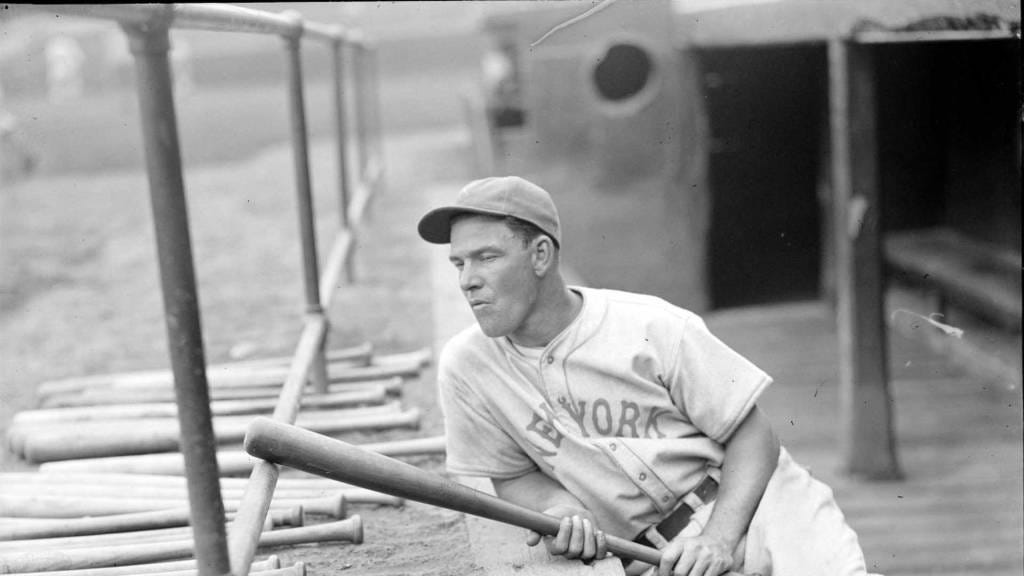
The venerable Ott – Master Melvin, they called him with good reason – was beginning his 17th season with the Giants, starting as a teenager fresh out of Gretna High in Louisiana. He had become one of the most-feared hitters in the National League, leading it five times in home runs. But Ott would also be managing the team for the first time and hoped Moss could become a reliable, occasional replacement in the outfield.
The kid made the Giants’ Opening-Day roster as Ott’s backup, but he hurt his leg in his first game sliding into second base. He went hitless in the next seven games, and the Giants shipped him across the Hudson River to their Class AA team in Jersey City, New Jersey. Moss, who enjoyed a few beers with teammates in the clubhouse after games, refused to play for its manager, Frank “Pancho” Snyder, who had a reputation as a strict disciplinarian.
Bouncing in the Bushes
The Giants then sold him to the St. Louis Cardinals, and Moss finished the season with their Class AA club in Columbus, Ohio, where he hit only three homers in 95 games. He would later attribute his low home-run totals in the early 1940s to the “dead balls” then used in the minors.
Back with the Giants in 1943, Moss agreed to play in Jersey City after Snyder had been fired. Midway through the season, a tumor on his foot began to hinder his play “By the end of the season, the pressure got so bad that I could hardly walk,” he remembered. He hit .233 with only five home runs and was released at the end of the season.
Moss worked in a factory in Hoboken, New Jersey, and thought his baseball career was over. Just as one powerful baseball fan insured that Moss could start his career, another came along that winter to resurrect it. Frank Hague, the last of the country’s political bosses, had been mayor of Jersey City since 1917. Like the Tammany bosses of old across the river in Manhattan, Hague ruled through fear, force and favor. He had a soft spot for baseball, however, particularly in his hometown. He referred Moss to doctors, who removed the tumor and treated his foot with radiation. The move backfired because the Moss signed with the Baltimore Orioles, the Cleveland Indians’ Class AA club.
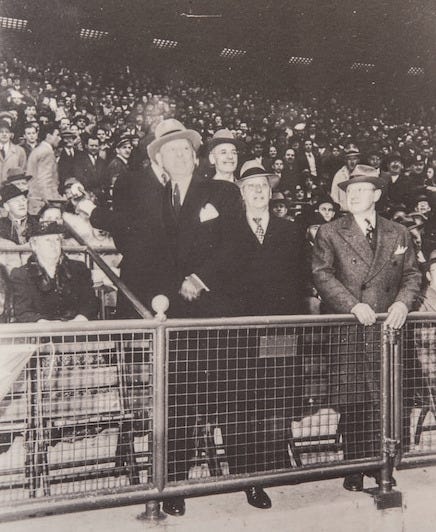
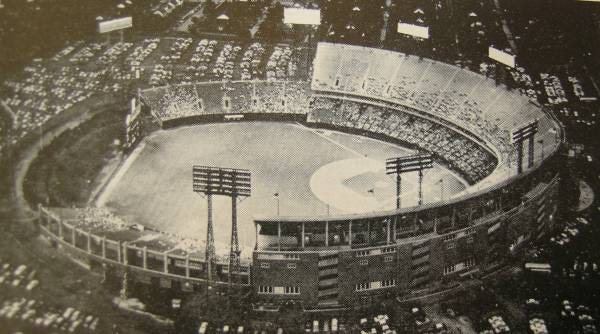
Once a powerhouse in the minor leagues, the Orioles that Moss joined in 1944 hadn’t won a pennant in almost 20 years.3 The team, though, was leading the International League, then one step down from the majors, on July 4th, when its park burned down. It moved several blocks to the old football bowl Municipal Stadium.
The place was a dream come true for a dead pull hitter like Howie Moss, who came out of the Orioles’ dugout swinging. Beckoning, 280 feet away, were the left-field bleachers. Moss knew paradise when he saw it. He had wrists quick enough to turn on most minor-league fastballs and a slight uppercut in his swing that provided what hitting coaches today call launch angle. They would combine to make him the most feared home-run hitter in the minors in the mid-1940s, the only player in its 140-year history to lead the storied International League four times in homers. He challenged for its home-run record one season and was its Most Valuable Player in another when he took the Orioles to the Junior World Series. Those achievements earned him a place in the league’s Hall of Fame.
A Slugger Is Born
Bill Dyer, the Orioles’ flamboyant radio announcer with a fondness for alliteration, came up with the nickname after watching Moss take repeated aim on the short porch. The Howitzer, though, always seemed to resent the implication that the stadium had anything to do with his home-run prowess. “I hit ‘em as far as anyone,” Moss once boasted.
The Orioles won the pennant with Moss as their hitting star. He led the league in homers for the first time with 27 and also in runs batted in (141), hits (178), and doubles (44). The Orioles went on to beat the Louisville, Kentucky, Colonels of the Class AA American Association in the Junior World Series,4 and Moss was named the league’s MVP.
After a year in the Navy in 1945, Moss picked up where he left off and was the league’s leading home-run hitter for the next three seasons, which included a memorable battle with Hank Sauer of Syracuse Chiefs in 1947 for the title. Orioles’ Manager Tommy Thompson offered Moss a bonus if he won. “It was a tall order,” Moss remembered. “I was 10 homers behind him with only three weeks left to play. But I got my home-run stroke going and pulled even with him with a little over two weeks.” Both had 50 with four games left. Moss belted his 51st at Syracuse’s MacArthur Stadium and hit two more in Jersey City. Meanwhile, Sauer, who would have a long career in the National League, went on a drought. Moss won the crown with 53, 10 shy of the league record.
He got two more shots in the majors, both in 1946, but The Howitzer shot blanks. He played seven games for the Indians and eight for the Cincinnati Reds, combining for seven singles that amounted to an embarrassing batting average that failed to break .100. Maybe, Moss thought, a bit of bad luck had something to do with it. “I never believed in alibiing,” he once said, “but every time I got a chance to go somewhere I either wound up on crutches or in a cast.”
Orioles players were puzzled at their slugging teammate’s failure. “I don’t know what happened that he didn’t make it,” pitcher Ray Flanigan said years later. “Maybe he couldn’t handle the good fastball up and in, but that goes for a lot of hitters. I do remember that he’d chase a bad curve ball when he got behind in the count but, again, so many others do that, too.”
Claiming that they were paying him too much, the Orioles wanted to cut his $6,000 ($75,000) salary in 1949 but traded him to the Boston Braves after Moss reacted angrily and publicly. He had two good seasons with the Braves’ Class AA franchise in Milwaukee, Wisconsin, clubbing 58 homers and hitting close to .300.
Moss bounced around the minors for two more seasons, ending his career at home in 1952 with the Class B Gastonia Rockets. “I was just beginning to get back in the groove when I broke a toe,” he said. “That ended it for me.”
He retired after 13 seasons in the established minor leagues with 263 home runs and 811 RBI. He was inducted into the International League Hall of Fame in 1960.
Moss had started selling cars during the off-season in 1951 and became a fixture at the Buick dealership in downtown Baltimore for 30 years. Married twice, he had three children. He died in 1989.
The original teams were the Charlotte Hornets, the Concord Weavers, the Forest City Owls, the Hickory Rebels, the Kannapolis Towelers, the Mooresville Moors, the Salisbury Colonels, and the Shelby Cee Cees.
The outlaw league doesn’t share a history with the current Class A Carolina League, which started in 1945 and whose teams have always been affiliated with major-league teams.
There have been five professional baseball teams in Baltimore named the Orioles. Four played in the major leagues. This minor-league team started in 1904, briefly relocated 10 years later to avoid competition with the renegade and short-lived Federal League, and returned to Baltimore in 1916. Six of its teams, most in the 1920s, are considered to be among the top 100 teams in minor-league history. The team was forced out of town for good after the 1953 season by the American League’s St. Louis Browns, which relocated to become the modern Orioles. The old Orioles moved first to Richmond, VA, and then to Toledo, OH, where they play today as the Class AAA Mud Hens.
The Junior World Series was a postseason championship between the pennant winners of the two of the three highest minor leagues, the International League and American Association. When created in 1904, it was called the Little World Series. The name was changed in 1933. The last one was held in 1975.
Another modern-day ritual around this time of year, is the preparation of one's fantasy baseball draft list. From what i am seeing within the 2026 projection systems, The Howitzer's .233 season with one homer could very possibly land him in the majors in a platoon...probably a couple of million per year to boot. The stats of yesteryear are gaudy compared with today's players and today's game.
Well written...an enjoyable read.
He sure spoke up for himself a lot for a guy with so little MLB cred....