
Gordon Gray
Maybe the Most-Important North Carolinian of the 20th Century Who Few Remember

Note: I hesitated posting this. We live, after all, in an age of tweets and fleeting attention spans, of 10-second Facebook reels and two-minute YouTube “docuvideos.” This is old school, I know. It’s long and requires you to commit some real time. I hope you do.
I’ve long had a fascination with Gordon Gray. I have written about him often over the years — in newspaper articles, in a book about the newspaper he once owned and where I once worked, in a weighty tome — literally — about important North Carolinians that a museum in Charlotte published. I have interviewed Gray’s sons and many of the people who worked for him. I’ve pulled the pieces together here.
Grab a another cup of coffee this morning and settle in. You’ll go back in time to a North Carolina that doesn’t exist anymore and meet a very serious man, who sat at the elbow of presidents to help them maneuver through a dangerous world. He was a man, I suspect, who would be very alarmed by the very unserious people who have taken his place.
Amid the hundreds of photographs of Gordon Gray saved at the University of North Carolina, there is one that says more about him than any other. The black-and-white picture, taken in April 1942, shows the young Gray boarding a bus in Winston-Salem that would take him off to war. Wearing a suit and tie, he was dressed pretty much like the other young men on the bus and probably would have slipped aboard unnoticed, a Gray trait, if not for the newspaper photographer trailing in his wake.
Though just 33, he was a man of money, power, and connections and he could have left town in a limousine with a captain’s commission in his pocket. That wasn’t the Gray way. A man succeeded on his own merits, the stern Bowman Gray Sr., had told his younger son, Gordon, who grew to believe it. To prove his point, the father, then the vice president of R.J. Reynolds Tobacco Co., put his ten-year-old boy to work at the lowliest job in the factory, pushing hogsheads of tobacco across the floors. In later summers, Gordon would advance to machine operator, but he was expected to report promptly at 7:20 a.m. each day like everyone else and work the normal 55 hours a week.
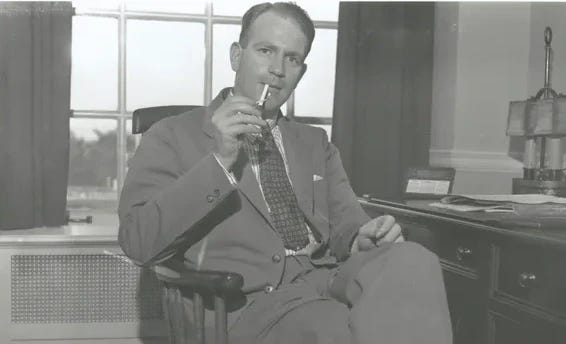
Gray learned the lesson well. After graduating at the top of his class at the University of North Carolina, he turned down Harvard Law School because it was willing to accept him immediately -- a sign that it might not be taxing enough. Yale’s law school, on the other hand, required an entrance exam. He chose Yale.
The same went for the Army. The easy way would have been to accept the captain’s commission and angle for some cushy duty defending San Francisco. Instead, Gray waited in line with other men at the local Army recruiting office and boarded a bus with everyone else for Fort Bragg. Two years later. he was in the thick of it in Europe.
The Army soon learned what Gray’s family and friends already knew: He was brilliant and determined to achieve. His score on the IQ test given to all recruits was the highest anyone at Fort Bragg had ever seen. Within seven years this red-haired buck private with the mild manners and aloof bearing would soar through the ranks to secretary of the army.
In the service of his government, Gordon Gray excelled. He was many things in life: lawyer, newspaper publisher, politician, university president, businessman. Nothing excited him more, though, than high officialdom. He stood at the pinnacle of power, where miscalculation could mean disaster half a world away. The global complexities of the problems he faced every day challenged Gray’s mind, while working unseen by the public in the shadows of government suited his shy, quiet temperament. “Gordon Gray was not a publisher, he was not a lawyer,” his son, Gordon Jr. said. “Gordon Gray was a public servant in the mid-19th century British style: stiff upper lip, you go to the ministry and put in seven days. He made better judgments than most people.”
He was an “idea man” who knew a great deal could be accomplished if he didn’t care who got the public credit for his ideas. Such men go far. Presidents put Gray’s incisive mind to work disentangling their thorniest problems. Harry Truman put him in charge of the army and then had him devise a plan to fight communism. Needing a cool head to look into the loyalty of America’s top nuclear scientist, Dwight Eisenhower reached into Chapel Hill and borrowed Gray, who was president of the state university system at the time. Later, Gray appeared at Ike’s elbow as his national security adviser, and he helped shape the country’s Cold War policy. Even in retirement, he advised presidents as different as John Kennedy and Gerald Ford on foreign policy and national security.
Who Is That Guy?
Gordon Gray became one of his generation’s most prominent North Carolinians, but few people outside the small circle of his family and friends knew who he really was. Bill Sharpe, who worked for him as an editor at the Winston-Salem Journal, offered this assessment in 1940, elements of which would be repeated later by journalists writing about Gray: “He has a genuine interest in public affairs and a notion of destiny, plus an unusual amount of ability for one so birthed. He has thousands of acquaintances but few friends, because it is not in the Gray blood to make or permit intimates.”
Reserved and cautious by nature, Gray spent a lifetime guarding his private life while cultivating the image of the dedicated public servant. He wrote thousands of letters during his various careers, many of which have been preserved, but few offer any glimpse into the soul of the writer. Reflecting Gray’s personality, they are direct and businesslike, rarely exceeding a page in length. Even his letters to his children at camp read as if they had been dictated to a secretary. Generals sang his praises when Secretary Gray left the Army, but on close questioning none could reveal any details about their former boss. A professor in Chapel Hill had to admit in 1954 that he knew little about Gray, who had been university president for almost four years. “Our contact with him lacks intimacy so it is extremely difficult to know what manner of man he is,” the professor told a reporter.
Employees on the newspapers that Gray owned for 32 years felt the same way. He spent fewer than seven of those years as an active publisher, leaving Winston-Salem for Washington in September 1947 and returning maybe once or twice a year for stockholders’ meetings. By 1953, Twin-City Sentinel reporter Frances Griffin could write in the company newsletter, Communique, that “the newsroom now sees him so seldom that many sitting at typewriters there have never seen him.”
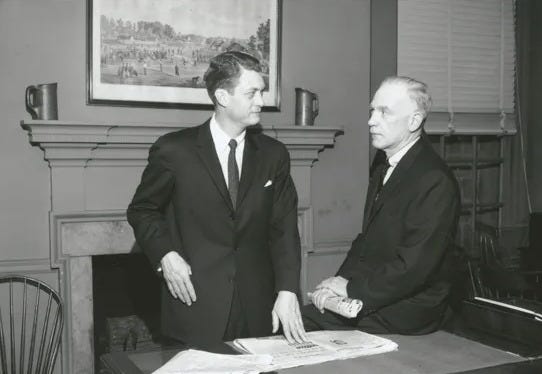
In the void, the myth of Gordon Gray developed. He took the form of a rich, benevolent uncle who held an important but rather hazy job in Washington. Some even whispered that he was a spy. He’d write employees notes on their birthdays and suddenly appear in the newsroom for a few hours each year, when he’d tell stories that hinted of the dark secrets he knew. Just as suddenly, he was gone. Even his cousin, James A. Gray III, had a hard time penetrating the mythical shell when he took over as publisher in 1959. “How would you like to have an owner 300 miles away?” he said. “You dare not call him because he’d be in some important meeting. He was like a demi-god that you couldn’t approach.”
Gordon Gray was an effective publisher but an indifferent one. He got into the business by accident after agreeing to be the point man in the bid by Winston-Salem’s monied men to buy the newspapers. They prospered under Gray because times were good and he hired experienced people and usually let them run the papers with little interference. But he never showed any signs that he enjoyed the work. There are no stories of him wandering around the press room when the first edition started rolling, as Owen Moon, the previous owner, often had. He didn’t take Linotype operators or reporters aside to talk to them about their work, and editors complained that he was more likely to give a speech to a civic group out in the boonies than meet with his editorial board on an important issue. The newspapers rarely received prominent mention in his letters, and Gray’s youngest son, Bernard, can’t remember their dominating a discussion at the dinner table. “I was always surprised at how little emphasis any of it had in his life,” he said.
The Weight of Family History
Gordon Gray realized early in life that he had a weighty family name to uphold. His great-grandfather Robert Gray had moved from his native Randolph County to the new county of Forsyth in 1849 and bought the first lot in the yet-unnamed county seat. He became one of early Winston’s leading merchants. Robert’s son, James, helped found Wachovia National Bank, and his grandchildren -- Gordon’s father and uncle -- worked diligently to turn the town’s leading employer, R.J. Reynolds Tobacco Company, into the world’s largest tobacco manufacturer.
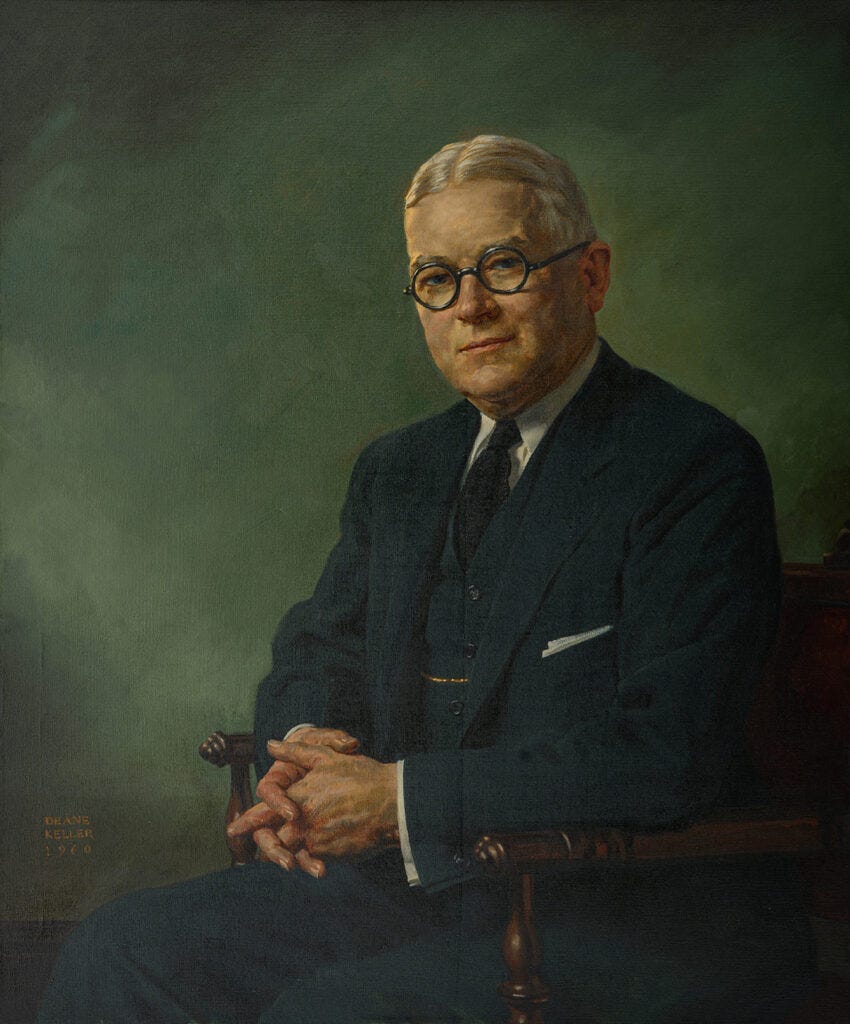
Being the son of one of Winston-Salem’s leading families gave Gray a powerful incentive to succeed. “Family name and family pressure certainly were motivators,” Bernard Gray said. “He was a very gifted person, and he was always reminded that he had a lot of offer.”
Bowman Gray, Sr., did much of the reminding. James A. Gray’s oldest son was living in Baltimore, where he was Reynolds’ eastern sales manager, when Gordon was born on May 30, 1909. The family moved to Winston three years later when Bowman was promoted to vice president. In 1924, he succeeded William N. Reynolds as president, the first person outside the Reynolds family to hold the job. By all accounts, the elder Gray was a strict disciplinarian who expected Gordon and his older brother, Bowman Jr., to be respectful, courteous and on time. “He was very stern, very much a Methodist,” his grandson, Gordon Gray, Jr., said. “He demanded punctuality. You were in real trouble if you were a minute late.”
The boys also were sure to hear from their father if they did not meet his high standards of hard work. Bowman Jr. once was asked by a dean at the University of North Carolina what drove him and his brother to excel in school. He credited his father with teaching them “first, never to be a quitter, and second, that the only basis on which a man was entitled to his self-respect was that of a worthwhile job well done.”
Bowman Gray, Sr.’s job was running Reynolds Tobacco. Showing the drive and single-mindedness that he passed on to Gordon, he devoted his life to the company, spending at least 16 hours a day there. He worked such long hours that coworkers feared for his health. Reynolds was the fourth-largest tobacco company in the world when Bowman became president. When he stepped down seven years later to become chairman of the board, the company was the largest.
Spending much of his day at the office, Bowman had little time for his children. Their mother, Nathalie, was often ill, and many of the duties of raising the two boys fell to Alice Gray, Bowman’s cousin. Called Polly or simply Pol by the children, Alice was a major influence on Gordon. She believed in discipline and setting rules, as did Bowman, but she also took time to talk to him. From her, Gordon learned that his wealth set him apart from other people and that responsibility came with the money. “Now remember, Gordon,” Polly said as the teenager climbed into his first roadster, “you never earned a cent of the money you’re about to enjoy.”
Gray attended West End Graded School and Reynolda School before moving on to Woodberry Forest, an exclusive prep school in Virginia where Winston’s wealthy sent their children. He didn’t want to attend college, but his father, who had always regretted never furthering his education, persuaded him to give it a try for a couple of years. Gray entered the University of North Carolina in 1926, but he didn’t expect to remain long. “I didn’t consider myself good college material,” he said later. He stayed four years, finishing at the top of his class and serving as president of Phi Beta Kappa. Two Cs his freshmen year were the only blemishes on an otherwise straight-A record, adding evidence to Polly’s assessment that Gray was the smartest man she ever knew. An English professor at UNC also remembered an intelligent young man, who was quiet and reserved and rarely asked questions in class. “I never knew a man who knew so much but said so little,” he recalled.
With a degree in psychology, Gray thought he’d like to try teaching, but again his father interceded. The senior Gray suggested law, and Gray sent application letters to Harvard and Yale. Harvard accepted him, but Yale wanted to first interview him and then have him take an entrance exam. Instead of being insulted, Gray thought that Yale would be the more exacting school. He again was a honor student and was appointed to the editorial board of the Yale Law Journal in January 1932 in recognition of his high ranking in his class.
After graduating the next year, Gray joined a New York law firm, but his father’s death in July 1935, brought Gray home to settle the estate. He then embarked on a new career.
The Joyless Job of Publisher
Gray sat down in the publisher’s office of the Journal and the Sentinel in 1937 knowing little about the profession he had stumbled upon. His entire experience in journalism consisted of a year as editor of the Fir Tree, the Woodberry Forest yearbook, and stints as business manager of the Carolina Magazine at Chapel Hill and editor of the Yale Law Review. He hadn’t taken any journalism classes at UNC and had gotten a C in one of his freshman English courses. “So far, the newspaper business has been about ninety percent grief,” Gray wrote to one of his old professors at Woodberry Forest a couple of weeks after buying the papers, “but I am hopeful that the situation will straighten itself out soon and that I will be able to enjoy it more...”
That would never happen. Gray had never aspired to be a publisher and, in fact, hoped to return to his law career after shoring up the newspapers’ crumbling financial foundations. Though he stayed on, the job just never excited him as his high-level positions in Washington later did. Employees found the new publisher to be something of a cold fish, a man who kept them at arm’s length and never got too involved in the daily running of his newspapers. “I don’t think Gordon was ever very happy with the newspaper,” said Chester Davis, one of the Journal’s star writers in the 1950s. “He spent so little time with it.”
No one, though, could accuse the boss of being lazy. Still a bachelor when he took over the newspapers, Gray arrived at the office early and stayed late into the evening, often bringing his lunch in a paper bag and eating at his desk. He was partial to egg sandwiches.
Neither could anyone question his ethics. “We conceive of the publication of a newspaper as a public trust and seek to meet our responsibilities in the light of that conception,” Gray wrote in a statement that appeared in the newspapers soon after he bought them. That’s why he called the newsroom one night to inform the city desk that he had been ticketed for speeding and to tell the editor that he expected to see the story in the next day’s newspapers. He kept a copy of the article framed on the wall in his office to ward off well-to-do friends who wanted him to stop stories they didn’t want printed.
Publisher But No Newsman
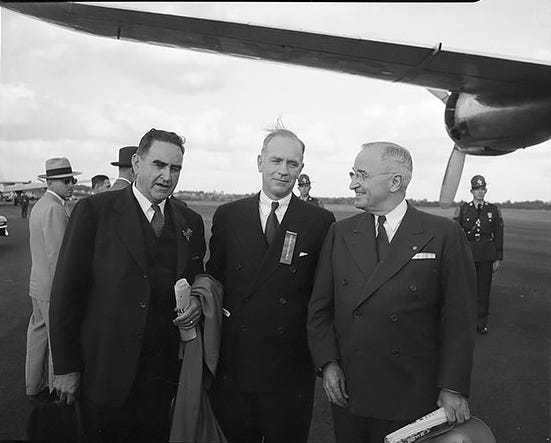
Throughout his career Gray had an odd relationship with the profession that he was involved in for more than 30 years. He didn’t think like a publisher and certainly wasn’t a newsman. He saw no reason, for instance, to call his newspapers when his plane developed engine trouble over North Carolina in August 1949. Gray, who was secretary of the Army then, and the other passenger, Fred Vinson, chief justice of the Supreme Court, were ordered into parachutes in case they had to bail out. The plane managed to land safely in Winston-Salem a few miles from Gray’s newspapers, but not a word appeared in either of them. It took a Washington reporter working on a tip to ferret the story out days later.
In Gray’s hierarchy of values, getting a story into the paper -- the ultimate goal of any newspaperman -- ranked somewhere near voting for Republicans. It never entered his mind. National security, Gray would have concluded if he had thought about it, certainly outweighed the citizens’ right to know that the heads of their army and their highest court were nearly forced to jump for their lives out of an airplane.
In a similar vein, Gray feared in 1946 that ill-timed publicity would sink the deal to bring Wake Forest College to Winston-Salem. Success was more important than being first with the news. Deeply involved in the secret effort to move the school from Wake County, he sat on one of the biggest stories in the city’s history. A Raleigh newspaper eventually beat Gray’s papers to the story. To Gray, it just wasn’t important.
In Washington, Gray’s circle of friends included a number of prominent journalists, but he was as suspicious of the reporters who covered the capital as were other high government officials. He gave interviews sparingly, and then the questions had to be limited to certain topics. Under no circumstances would he answer questions about his personal life.
Wallace Carroll couldn’t have asked for a better owner, though. Carroll joined the newspapers as executive editor in 1949, left for The New York Times a few years later, but returned in 1963 as publisher. Gray, who had relinquished the title 13 years earlier, met the primary requirement of an owner. “He never interfered with the paper,” Carroll said. “He realized that if he wanted good people, he had to let them use their professional skills. My experience with him was very good. I only came back here from the Times because I knew he’d me give absolute freedom to be the editor and publisher. He started off with the right idea about what a newspaper should be, and he never pushed my elbow.”
Neither did he earn a salary or give himself bonuses. “We were able to do things because Gordon took not a penny of profit from the papers,” Carroll continued. “He put all the profit back in. The fact that he didn’t take any publisher’s profit enabled us to go out and hire more people.”
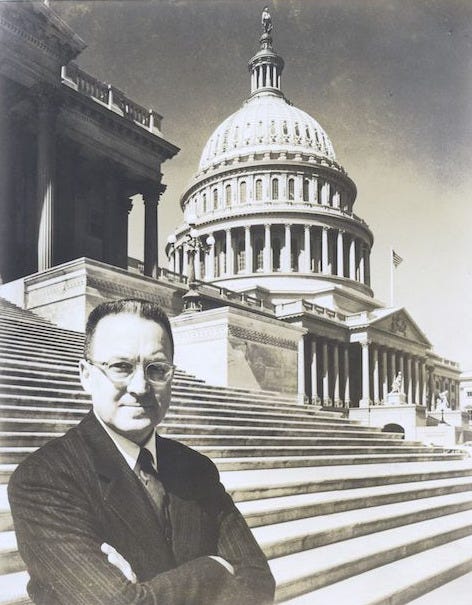
Mr. Gray Goes to Raleigh
The newspapers paid Gray back in other ways by opening doors for a young, bright, and ambitious publisher who was beginning to consider public service a career. Politics seemed to be the obvious choice. Gray was a staunch Democrat, as was everyone else who mattered in North Carolina at the time. He helped raise more than $44,000, or more than $1 million today, in Forsyth County for President Franklin Roosevelt’s reelection bid in 1936. A grateful Roosevelt invited Gray to dinner at the White House in January 1937 and sent him a congratulatory telegram when he bought the newspapers a few months later.
Gray announced his candidacy for the North Carolina Senate on April 2, 1938, after the incumbent in the 22nd District said he wouldn’t seek reelection. Bill Hoyt, the newspapers’ general manger, urged Gray not to run, arguing that publishers should maintain their objectivity. Gray, who normally valued Hoyt’s advice, thanked him and ran anyway. He had no opposition in the Democratic primary and handily beat his Republican opponent in November.
It was a family man who left for Raleigh the following January. Gray had known Jane Boyden Craige since childhood. A graduate of Vassar College, she was a vivacious brunette, who was half an inch taller than Gray. Their courtship came to a climax in early 1938 when Gray flew from Winston-Salem to Trinidad, arriving just as Jane’s cruise ship dropped anchor off Port-of-Spain. He joined the cruise and popped the fateful question a few evenings later.
The couple was married in an elaborate ceremony at St. Paul’s Episcopal Church in Winston-Salem on June 11, 1938. The newlyweds, Gray reported to a friend, received more than 900 presents.
Gray would serve three terms in the state Senate -- two before Pearl Harbor and one after -- and became known for his liberalism by supporting higher teachers’ salaries, tax relief, and better health care. Newsmen covering the General Assembly consistently voted Gray one of its most effective senators.
A man of impeccable dress and manners, Gray thought that courtesy was one of the foundations of success. “All law is society’s demand for good manners,” he once said in a speech. “Law seeks to insure orderly and predictable human behavior in man’s relationship to man.”
And his relationship to women. In 1941, Gray introduced a bill to crack down on rude behavior at airports by making it a misdemeanor to whistle at a woman or make remarks that would embarrass her. He took much guff for it in the halls of the legislature and on newspaper editorial pages. The bill passed the Senate but couldn’t get through the state House.
After the Japanese bombed Pearl Harbor in December 1941, Gray decided not to run for reelection the following year. Instead, he spent the summer at Fort Bragg, where he completed basic training and was promoted to corporal. The Army next sent him to its Officer Candidate School at Fort Benning, Georgia. He often would wander into the woods where an officer once found him shouting at pine trees. When questioned, Gray said he was trying to strengthen his voice in case he ever led a platoon in battle. Twice during training, he failed to climb the required ten-foot barricade. A worried Gray went to see the doctor, who looked him over and announced that Gray had a double hernia. He recommended an immediate operation, but Gray persuaded the doctor to hold off until he climbed the wall. Double hernia and all, Gray made it over the top on the third try. Then, he had his operation.
He graduated from OCS in 1943 as a second lieutenant and next found himself at Counter Intelligence School in Chicago. Gray was outranked by 90 percent of his classmates but finished at the top of the class. Promoted to first lieutenant, he was shipped back to Fort Benning and then eventually to Europe. He spent the last year of the war as an intelligence officer on the staff of Gen. Omar Bradley and the 12th Army Group in Europe. He was back home by March 1945.
The Meteoric Rise of a Buck Private
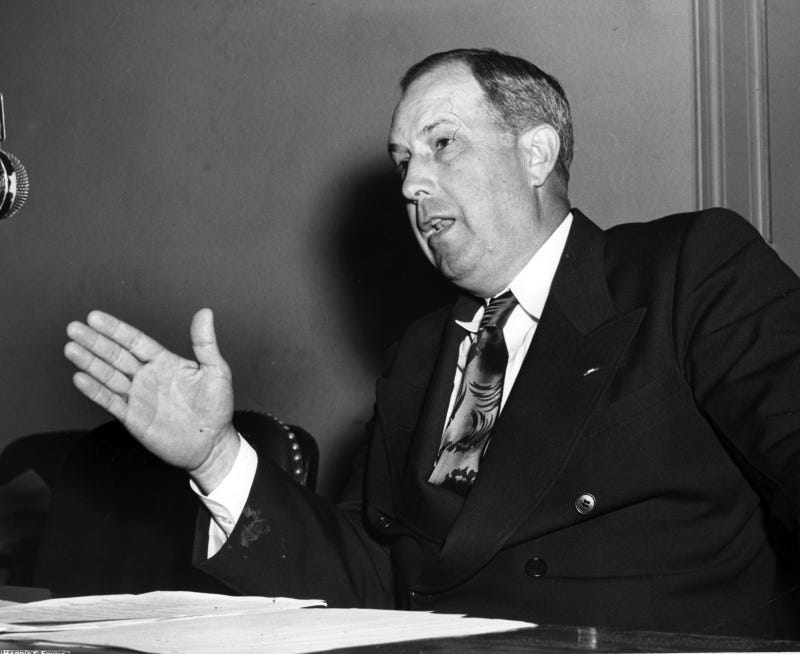
Kenneth Royall, the secretary of the Army, needed an assistant two years later. He was from Goldsboro, and he recommended a fellow North Carolinian for the job. President Truman announced on Sept. 24, 1947, that Gordon Gray, a newspaper publisher in Winston-Salem, would be the new assistant secretary of the Army. Gray left for Washington, which would be his home for most of the next 35 years. He put Hoyt in charge of his newspapers.
As assistant secretary, he did the usual things: toured army bases, testified before Congress, acted nice to Third World despots visiting Washington. Truman appointed him secretary to replace Royall in June 1949.
The first buck private to ever rise to secretary commanded more than 658,000 men and controlled a budget of $1 billion, or about $13 billion when inflation is factored in. Gray worked as if the money were his. Fourteen-hour days were not uncommon. While the rest of the government took Saturdays off, Gray was in the office tying up loose ends. He even worked on Sundays until co-workers, concerned by how quickly he had aged, suggested that he slow down. “I am taking it easy now,” Gray told a reporter in late 1949. “I don’t work on Sundays anymore.”
His schedule left little time for his wife, Jane, and their four boys: Gordon Jr., Burton, Boyden, and Bernard. He usually was gone by the time the children got up in the morning and he didn’t return home until after they had gone to bed. “He was too busy being whatever else he was,” said Gordon Jr., who was ten years old at the time. “He was in a zone and too busy for his family and his business. You guys down there (in Winston-Salem) were lucky that Bill Hoyt and Wally Carroll were there. We didn’t have anyone.”
Bernard Gray, the youngest son, was only two when his father headed the Army, but he remembers how busy Gray remained during the rest of his government career. He was more understanding than his oldest brother, but he describes a man who was more a functionary than a father. “He made the time (for his family), but it was very brief and to the point,” Bernard said. “He wasn’t a guy to spend a lot of time with. He did not ignore his responsibilities as a father, but he was in a very demanding job especially in the Ike years. No, I never went golfing with him or fishing. He just never had the time.”
Later, after Jane’s death in 1953, Gray called on Polly to raise his children, much as his father, Bowman, had. “My father developed a very strong sense of guilt for becoming a non-working father, as he developed into a non-working publisher,” Gordon Jr. said. “Just like he delegated authority to Bill Hoyt, he delegated authority to Polly.”
In Washington, Gray cultivated a few close friends: journalists Arthur Krock and Joe Alsop and Frank Wisner, who headed covert operations for the Central Intelligence Agency. They found that the usually shy and quiet Gray was witty and could become quite animated at small parties with friends.
At work, Gray took the first tentative steps toward integrating the Army. The era of black civil rights would soon dawn, and like many Southerners of his generation Gray was caught unprepared. His innate conservatism, though, told him to go slow. At his newspapers, with the Army, and later in Chapel Hill, he would support policies that provided for gradual integration. In October 1949, Gray ordered commanders to give black troops equal treatment and opportunities. The Army was still segregated on the company level, but black and white companies could serve side by side in battalions. By early 1950, “qualified” blacks were allowed into formerly all-white units.
An Answer to Their Prayers
By then, Gray was heading elsewhere. Surprising many of his friends and officials in the Truman administration, he resigned as army secretary in the spring of 1950 to accept the job as president of the consolidated University of North Carolina. “I don’t think that he wanted to come back to North Carolina to be president of UNC,” Gordon Gray, Jr., said. “It was a diversion, but I think he could not say no.”
He tried in December 1949, when the committee looking for a president visited him at his office in Washington. Frank Porter Graham, president of the university for 29 years, had been appointed to the United States Senate in March 1949 to complete the term of J. Melville Broughton, who had died in office. A nominating committee appointed by Gov. Kerr Scott spent nine months traveling more than 50,000 miles to interview 200 prospects. Gray thanked the committee members for thinking of him but advised them to look for someone with experience in college administration.
Many influential North Carolinians felt the same way. They’d been chagrined when the legendary Graham left the post. He had come to symbolize the university, and his name and reputation inspired respect across the state. Only a man of nearly equal stature could hope to replace him. The Raleigh News & Observer particularly liked the president of Yale, whom it pushed for the job.
The nomination committee, though, unanimously forwarded Gray’s name to the executive committee of the university’s board of trustees. Some of the trustees had grown tired of Graham’s liberal activism and liked the more quiet and conservative style that Gray was sure to bring to the job. In January 1950, the executive committee, unanimously commended Gary to the university’s full board of trustees for final approval. All one hundred trustees voted for Gray on February 6. William D. “Billy” Carmichael Jr., the university’s controller, business manager, and acting president, told reporters that Gray was one of UNC’s most stellar alumni. “The prayers of the faithful have been answered.” he concluded.
Gray wasn’t quite done with government work, however. He was not to take over in Chapel Hill until September 1950, and he could have gone off that spring and summer on a well-earned vacation. Instead, he served as a special assistant to Truman on foreign economic policy. His job was to devise a plan that would continue the economic development of Europe after the Marshall Plan expired in 1952. Gray’s instructions changed after North Korean troops stormed south on June 25. Truman wanted a strategy to put American economic might to use warding off communists. Gray worked feverishly to produce what became known as the Gray Plan, which recommended spending $10 billion in five years to block communism in 40 key countries. The report was immediately controversial. Though he praised it, Truman was careful not to endorse the report, which died in Congress.
That a fiscally conservative man like Gray would be willing to spend $10 billion -- real money in 1950 -- to stop communism showed just how serious a threat he considered it. Wisner probably reinforced those fears with stories about the atrocities the Red army had committed in Romania, where hewas a spy after the war. Fear of the bomb, the Korean War, and McCarthyism may have even gotten the better of Gray, a man not normally driven by emotion or swayed by innuendo. “It was an obsession, a fanaticism in those days,” Gordon Gray, Jr., says of his father’s anti-communism. “My father took a very public stance about it because it was part if his formula. It furthered him along in that circle. Many men of ambition and public service shared the same feelings about communism. Anybody who took a different stand went up before hearings in Washington.”
Facing the “Red Threat’
Where a candidate stood on the Red Threat was even an important consideration in choosing the new university president, given all the talk about Communist professors twisting the minds of college students. Such characters, if they lurked on the faculties of the state university campuses, would be found and immediately fired, Gray told a UNC alumni group in Washington that spring.
He repeated the theme in his inaugural address on October 10 “We shall not provide asylums for those who would extinguish the lights of liberty...” Gray told the audience in Reynolds Coliseum in Raleigh. “We shall not knowingly allow any campus to become a workshop, or laboratory, or training ground for the operations of those who are committed to the destruction of American cultures and institutions.”
Gray made it clear, though, that he didn’t think that the Communist influence on the campuses was a “major concern.” He promised that there would be no witch hunts. “We shall approach the problem sensibly and with restraint,” he said. “We shall not persecute the innocent, nor malign the clearly misunderstood.”
The youthful-looking president exuded confidence. He was only 41, and, at 160 pounds, weighed about what he did when he first arrived on the Chapel Hill campus twenty-four years earlier. He had steady blue eyes, fair skin, and hair that was graying at the temples. “He speaks in a quiet, deep-toned voice and maintains a mild-mannered bearing which inspires friendliness but a reserve which precludes intimacy,” a reporter described Gray at the time. Star-studded generals were unabashed in their praise of their former boss, and everyone from childhood playmates to the president of the United States told the reporter that Gray was honest, fair-minded, tenacious, patient, thorough, and, of course, hardworking.
His first day on the job, Gray was in his office at 8:25 a.m., and he stayed until 6 p.m. After a couple of weeks of this, Robert B. House, UNC’s chancellor, noted that the new man “drives himself. He is a late sitter and an early riser, and he keeps longer hours than anyone in the university.”
What he wasn’t was another Frank Porter Graham. Gray lacked his predecessor’s missionary zeal and personal charm. Neither did he have Graham’s activism or roots in academia. One professor commented that the new president knew nothing about “the style of the academy.” Gray, though, was a fast learner. He wryly observed that his jobs as secretary of the Army and president of the university were similar, except on the faculty there was no one below the rank of general.
Formal and Businesslike
Gray brought an aura of formality and businesslike style to the president’s office in South Building. One of his ongoing projects was to reorganize the administrative structure of the university system, which at the time consisted of three campuses: the University of North Carolina at Chapel Hill, North Carolina State College in Raleigh, and the Woman’s College at Greensboro. He spent $80,000 on a management study consisting of seven parts, 28 chapters, and 367 recommended changes. More than 100 of those changes were implemented by the time Gray left the university in 1955.
He also was active in raising the academic standards of athletes and is credited with being one of the founders of the Atlantic Coast Conference. During his tenure, four-year medical, dental, and nursing schools opened, and the Health Affairs Division of the Chapel Hill campus expanded rapidly.
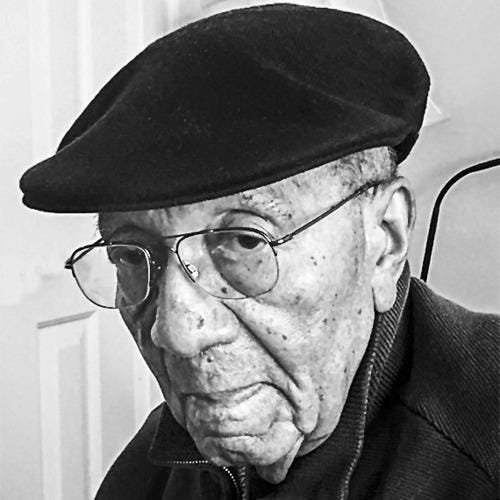
As he had for the army, Gray started the state universities down the rocky road to integration, but he showed he was willing to get off if the speed was too fast for his liking. He was all for going slow. At his urging, the trustees’ executive committee voted in March 1951 to allow blacks to attend some graduate schools if similar programs weren’t available at the state’s black colleges and if the applicant met all the academic qualifications. Such an arrangement maintained the “separate-but-equal” policy but allowed limited exceptions.
The federal court of appeals in Richmond raised the speed limit a few days later by overturning a NC court and ruling that UNC must admit blacks to its law school and presumably to other graduate and professional departments. The case involved four black students who had been barred from attending UNC’s law school because the state provided a law school for blacks at NC College in Durham. The court of appeals ruled that it was unconstitutional to force black students to attend just one school. Gray urged the state to appeal to the US Supreme Court. After the high court refused to overturn the lower court’s decision in early 1951, the trustees voted to allow three, and then eventually four, black students to enter the law school.
The trustees had earlier voted to allow blacks into the medical school. Gray tried to explain to opponents that they really had no choice because the Chapel Hill campus had the only public medical school in the state. The first black medical student, Edward Diggs, came from a prominent family in Gray’s hometown of Winston-Salem.
Gray didn’t do much to make the new black students feel welcome. They couldn’t use the university swimming pool or locker rooms, and they slept in separate rooms on the third floor of Steele Dormitory.
Even with three colleges to run, Gray found time to take on odd jobs for presidents. “This will sound corny,” he told me years later, “but I don’t think you have the right to refuse a call from the President of the United States for service for which you are equipped, unless there are compelling reasons. In my case, there weren’t.”
In 1951, President Truman appointed Gray the director of the Psychological Strategy Board, whose mission was to coordinate the activities of government agencies in nonmilitary aspects of the Cold War. Truman had pressured Governor Scott, chairman of the university board of trustees, to allow Gray to take job. The trustees reluctantly authorized Gray to spend two days a week in Washington. He started those days at 6 a.m., working a few hours at his desk in Chapel Hill before boarding a plane to Washington. He spent a few hours there and then flew back to Chapel Hill, where he often worked until midnight.
Investigating Oppie
Republican presidents came calling as well. Dwight D. Eisenhower had a problem in 1954 that needed a deft touch. Rumors had persisted for years about the loyalty of J. Robert Oppenheimer, the chief scientist on the team that produced the first atomic bomb. One of America’s most respected scientists, “Oppie” headed the Institute of Advanced Study at Princeton University and was a consultant for the Atomic Energy Commission. A few days after taking office in July 1953, Lewis Strauss, the commission’s new chairman, decided to withhold Oppenheimer’s security clearance until an investigation of the rumors was completed. The letter notifying him of the investigation contained sixteen specific charges that accused him of Communist affiliations and friendships before and during World War II. He had explained most of the charges already, but one new charge accused him of trying to delay development of the hydrogen bomb.
To clear his name, Oppenheimer asked for a hearing. The commission appointed a three-man board to look into the charges and to offer a recommendation. Eisenhower needed a known anticommunist, but one who could also be judicious and fair, to chair the panel. The chairman also would have to be cool-headed in the face of what was sure to be unremitting publicity once the news leaked. Ike chose Gordon Gray.
What became known as the Gray Board began its hearings on April 12, 1954, and the story broke to banner headlines across the country the next day. After almost four weeks of confidential testimony, the board recessed in late May to consider its findings. Its recommendation on June 1 struck many as peculiar. All three board members found that Oppenheimer was a “loyal citizen” and had been “discreet” in handling atomic secrets, but it voted 2-1 that his security clearance be denied. Gray joined Thomas A. Morgan, a fellow Tar Heel and former president of the Sperry Corporation, in voting against Oppenheimer. Ward V. Evans, a professor at Loyola University in Chicago, thought his security status should be restored.
Gray explained later that he and Morgan were uneasy that Oppenheimer didn’t take security seriously and continued to associate with suspicious people. They also didn’t think that the scientist was entirely candid about his foot-dragging when developing the hydrogen bomb. With such doubts, Gray and Morgan said they had no choice but to err on the side of caution. The Atomic Energy Commission concurred with the board’s findings later in June.
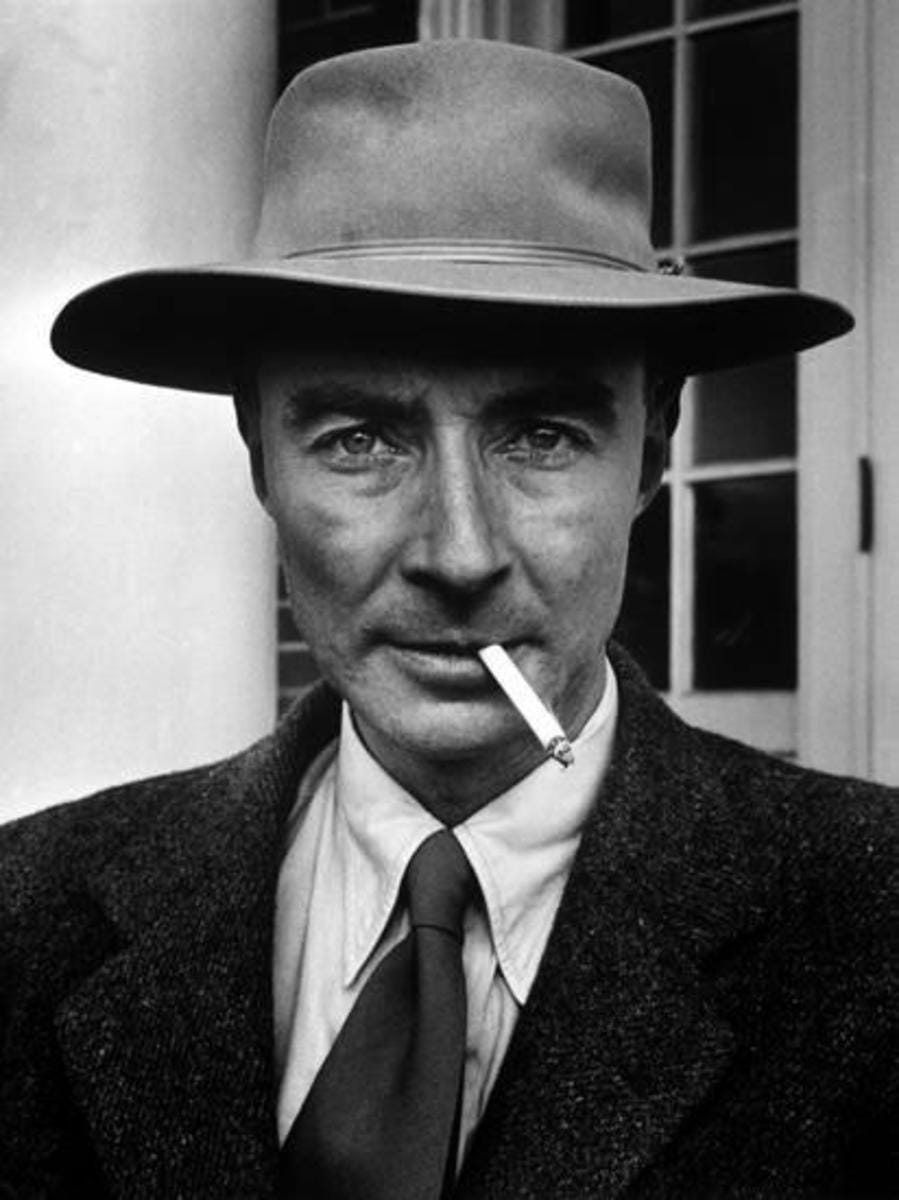
The Oppenheimer decision wasn’t popular in academia, and it increased the uneasiness those back home were having with Gray. Officials and alumni at the state’s universities were grumbling that their president was spending as much time in Washington as in Chapel Hill. The dissatisfaction reached the editorial pages in June 1955, when Eisenhower appointed Gray assistant secretary of defense for international security affairs. Newspaper editorials across the state noted that it was the third time Gray left his school duties to answer Washington’s call. The university, editors noted, needed a full-time president. Gray had offered to resign, but the university trustees had refused, preferring to give him a six-month leave of absence. In the face of mounting criticism, the trustees accepted his resignation when Gray again submitted it in November.
Eisenhower kept giving his able aide ever-increasing responsibilities. In November 1956, he appointed Gray to head the Office of Civil and Defense Mobilization. It wasn’t a cabinet post but it had cabinet rank and gave Gray a seat on the National Security Council. By law, he was the only man in the country who could certify an industry as being essential to defense mobilization, thus protecting it from imports under an escape clause in trade law. A “free trader” by nature, Gray made it clear that protection would be given to industries only under the most severe circumstances. Even so, his decisions made him powerful enemies. When he ruled that foreign oil was hindering the potential of domestic oil, for instance, the multinational oil companies howled in protest.
At a time when nuclear war was considered a likely enough threat that people were building fallout shelters in their basements, Gray was the man the country would depend on to help them survive an attack. His awesome responsibilities included maintaining the economy and the national government in case of a nuclear war. He had to move the president and his staff to a safe place, relocate destroyed industries to working factories, keep communications open among government agencies, establish and stock fallout shelters, and maintain a list of people who could substitute for key officials lost, killed or disabled.
Best Job in Washington
It was all leading up to July 23, 1958, when Gray got what he had to think was the greatest job in government. He replaced Robert D. Cutler as Eisenhower’s national security adviser. Here was a job that would test his organizational skills and his prodigious capacity for work. He would be privy to the country’s deepest secrets and would share in solving its most dangerous problems. And he’d do it all in the quiet of official anonymity.
A special assistant for national security affairs, Gray’s main task was running the National Security Council, created in 1947 to coordinate all government activities -- military, economic, propaganda, intelligence -- that affect national security. It met every Thursday at 9 a.m. in the Cabinet Room of the White House but also had special sessions during emergencies. Its regular members were the president, the vice president, the secretary of defense, the chairman of the Joint Chiefs of staff, the director of the CIA, and the director of the Office of Civil and Defense Mobilization. The council took no votes and made no decisions; its only role was to advise the president.
To prepare for each meeting, Gray chaired what he called the “Junior Council,” officially known as the National Security Council Planning Board. It was made up of deputies or assistants of the council members. They prepared agendas, summaries of agreements or disagreements, and sometimes position papers.
Gray also served as a moderator at National Security Council meetings, making sure discussions didn’t get bogged down and that all viewpoints got a chance to be heard by the president. Finally, he prepared minutes of the meetings.
As security adviser, Gray knew everything worth knowing about the country’s military strength, its latest weapons, its international commitments, and its strategic plans for coping with the Soviet Union. He insisted that he didn’t set policy, but by defining the issues that the National Security Council discussed each week he was indeed helping shape policy. He certainly had the ear of the president, who conferred with Gray at least three times a week.
During the 17 months that he had the job, Gray had to contend with China rattling swords in the Formosa Strait and threatening Taiwan, with Castro down in Cuba, with the humiliation after the Soviet Union’s shot down Francis Gary Powers in his U-2 spy plane, and with dozens of minor flareups in Africa, the Mideast, and elsewhere.
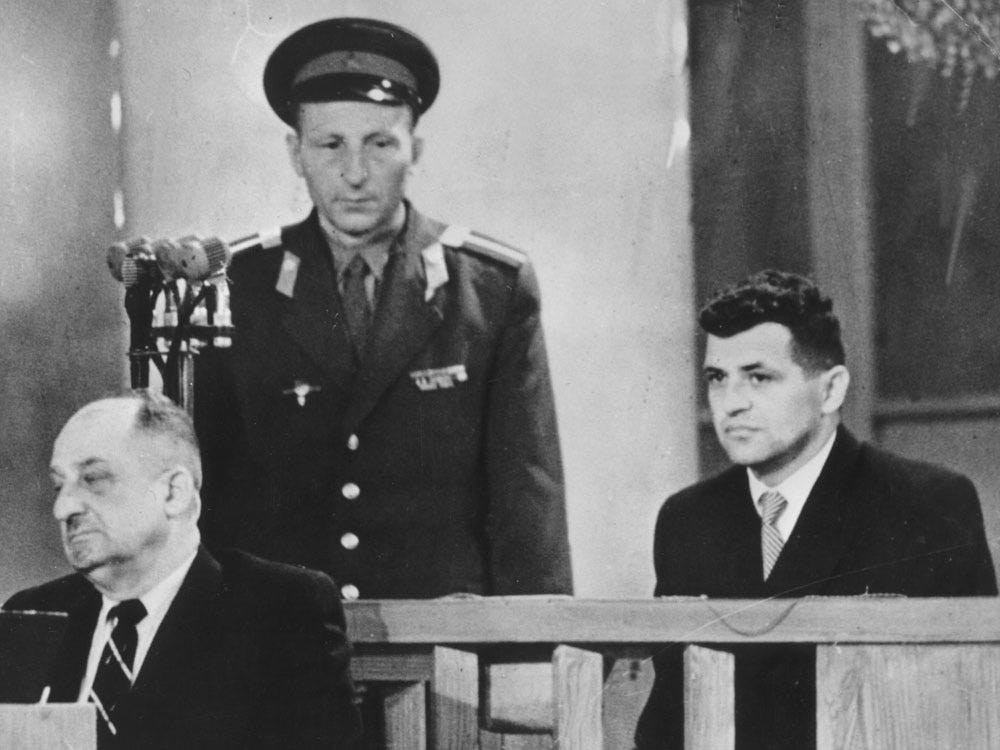
Gray sounded relieved when he announced in November 1960 that he would retire from government service when President-elect John F. Kennedy’s Democratic administration took over in January. “I’ve lived from crisis to crisis,” he said. “I need to regain my perspective, to change speeds, and thus reassure myself that the fate of the world doesn’t depend entirely on Gordon Gray.”
The Journal commented editorially a few days later that the paper found out about the retirement as it had everything else in Gray’s career: from the wire services and its own reporters. “He has never permitted this personal association to provide these newspapers with any sort of private pipeline to him and the government positions he has held,” the newspaper noted.
In his final Christmas note to Gray, Eisenhower wrote: “Personally and officially, your counsel, assistance and your very presence have meant much to me... Let me thank you once again for your invaluable contribution to the people of our country, and at the same time urge you to keep the ranks closed and the colors flying.” Before leaving Washington in January 1961, Ike awarded Gray his second Medal of Freedom, the government’s highest civilian award. Eisenhower had given him one in 1957.
Gray and his second wife, Nancy Maguire Beebee, whom he had married in 1956, spent 38 days cruising the South American coast. Gray returned to Winston-Salem, occupying the desk he had left in 1947. “I’m unemployed at the moment,” he said, “but not in retirement.”
‘Of Him Much Is Expected’
Neither was he long out of government service. He knew too much. President Kennedy, smarting from the CIA fiasco at the Bay of Pigs in 1961, established the Foreign Intelligence Advisory Board to keep watch over the American intelligence activities, mainly those of the CIA. He appointed Gray one of its seven members. Gray would serve under four presidents until 1977, when the board was dissolved by President Jimmy Carter.
The 1960s were hard on Gray. Many of the beliefs he cherished were questioned, even ridiculed, in popular culture. Decorum and civility seemed to be giving way to lawlessness. Leaders were gunned down in the streets, blacks rioted in the cities, and university students turned campuses into battlegrounds in their protests against the Vietnam War. As an old Cold Warrior, Gray supported the war, but his enthusiasm waned as it dragged on, his son, Bernard, said. “Vietnam was a very difficult thing for him. There I was getting my ass shot at and there he was pounding the table as a hawk and advising the presidents,” he said. “His view changed by the late 1970s. He started to realize that we didn’t accomplish anything.”
Gray devoted much of his time in the 1960s to the National Trust for Historic Preservation. In Georgetown section of Washington, he had lived around the corner from the old City Tavern, which he helped preserve. A friend, David Finley, was chairman of the trust, and he persuaded Gray to join the board. He became chairman in 1962 and served in that position for 11 years. He lobbied for the National Historic Preservation Act, writing the bill and finessing it through a reluctant Congress in 1966 by calling on those contacts he had made in Washington. The law expanded the National Register of Historic Places and gave tax incentives for restoring historic buildings. By bringing federal money to historic preservation, the act broadened the trust from a small elitist group working with state grants to a national movement.
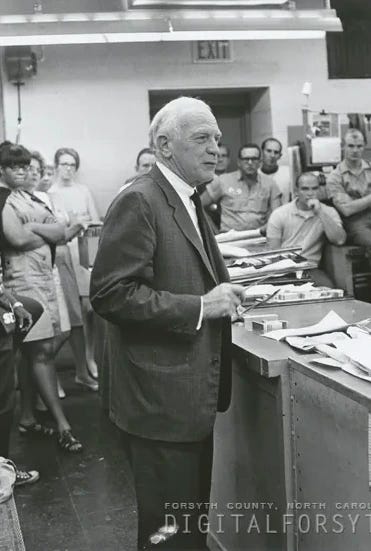
Gray was attending a meeting for the trust in San Antonio, Texas, in October 1964 when he suffered a heart attack at age 55. He was in the hospital for almost a month but on his release said he expected to resume his normal activities. Bernard Gray, though, said his father essentially retired after the illness. His formally hectic pace was reduced to attending to his beautiful orchids at his home and acting as an elder adviser to presidents.
Gray sold the Journal and the Sentinel in 1969 to Media General, a newspaper holding company owned by his friend, D. Tennant Bryan in Richmond, Virginia. He remained chairman of Triangle Broadcasting Company, which included WSJS radio and television. He sold the television station in 1975 and formed Summit Communications Inc. in Winston-Salem, which owned and operated WSJS Radio, a number of television stations, and cable television franchises.
Gray died at his home in Georgetown in 1982 after a long bout with throat cancer. He was 73. William Friday, the president of UNC, said that his predecessor took seriously the biblical injunction “to whom much is given, of him much is expected...”