
Wallace Carroll
A Newsman's Newsman Who Quietly Led by Example

In those days when they mattered, newspapers were led by titans: Ben Franklin, Joseph Pulitzer, Horace Greeley, William Randolph Hearst, Adolph Ochs, Katherine and Phil Graham. North Carolina had its share. Josephus Daniels, the owner of the News & Observer in Raleigh, was a leader in the Democrat Party, a Navy secretary, and a diplomat. Gordon Gray, publisher of the Winston-Salem Journal and the afternoon Twin City Sentinel, also headed the state university system, was secretary of the Army, and worked for decades in the shadows of government. At the elbow of presidents, he helped devise the country’s Cold War policies as a national security advisor. I maintain Gray is the most significant North Carolinian of the 20th century whom few now remember. More on him at a later date.
Today, we’ll focus on another of those giants whom you’re likely reading about here for the first time. Gray hired Wallace Carroll to run his newspapers while he was off tending to the universities or fending off the Soviets. When Carroll joined the Journal staff as its executive editor in 1949, Roy Thompson, a reporter and soon-to-be star columnist, reacted as did many other staff members. “When I sized him up, I wondered what he was doing here,” he said.
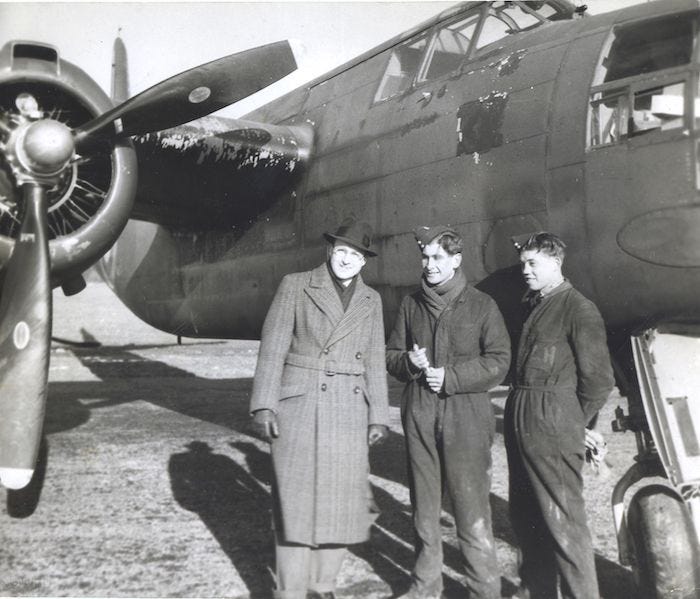
He arrived with an impressive resume. A native of Milwaukee, Wisconsin, Carroll graduated with a journalism degree from Marquette University in 1928 and worked on Wisconsin newspapers before joining United Press in Chicago. He was with the wire service’s London and Paris bureaus and managed the UP’s desk at the League of Nations in Geneva in 1934.
When World War II started, Carroll was back in London heading the service’s bureau. The sirens began to wail around noon on that Sept. 7, 1940. He raced to the roof of his office building as the first Stuka bombers dived from he clouds to begin the Battle of Britain. Carroll remained on the rooftop until after dark, dictating a running account by telephone to the copy desk in the offices below. In the morning, his story led every newspaper in America.
After the Nazis invaded Russia in 1941, Carroll attended a press briefing led by Gen. George C. Marshall, the chairman of the Joints Chief of Staff, who predicted that the Soviet army wouldn’t last six weeks. Carroll went to Russia to find out. He boarded a merchant ship in the Allies’ first convoy to Murmansk and was the first Westerner to tour the Eastern Front. He realized that Joseph Stalin, the Soviet dictator, had pumped a great deal of money into his army. Carroll’s series of stories correctly predicting that the Russians would survive the invasion won a National Headliner Award.
He returned to the United State by way of the Far East. His ship was the last to leave Manila before the Japanese attack in December 1941. Pearl Harbor was still smoldering when he docked there, and he was the first newsman allowed to tour the wrecked base. He couldn’t write about what he saw, however, because the government wanted to keep a lid on the extent of the destruction.
Carroll spent the remainder of the war in London, working in the shadowy world of counterintelligence. He directed a strange collection of poets, admen, writers, and newsmen at the U.S. Office of War Information, a government agency that produced leaflets and phony radio broadcasts, newspaper stories, and telegrams to misdirect and confuse the Germans. Reporting directly to Gen. Dwight D. Eisenhower, the supreme Allied commander, Carroll took part in the planning of the invasions of North Africa, Sicily, and Italy. From that experience came his book Persuade or Perish, published in 1948.
He was kicking around Washington after the war, writing his book and looking for a job. He was considering returning to Europe, when a friend, Frank Wisner, told him about a publisher in North Carolina who was looking for an executive editor. Wisner, one of he founding officers of the CIA, had known Gray since the war when both served in intelligence services.
At lunch a few days later, Carroll and Gray hit it off immediately. With a job offer in hand, Carroll and his wife, Peggy, visited Winston-Salem and decided it was a good place to raise their children.
A master of reportorial detail, Carroll replaced Leon S. Dure, who was known more for his long-winded monologues than his writing skills. The new boss had a very different style, noted reporter Paxton Davis. “His presence was calm, measured, precise,” he wrote in his memoir A Boy No More. “And his experience and good sense gave the Journal both perspective and depth, to all of which he added a crisp, lucid writing style that permitted him to make the unfamiliar complexities of world events clear and to step in, when necessary, to untangle the syntactical knots in local copy.”
Grammatical indiscretions, misspellings, misplaced commas, and other literary failings that slipped past editors and into the paper usually found their way onto the newsroom bulletin board, where Carroll posted the offenses with attached notes. In that way, he taught young journalists their craft.
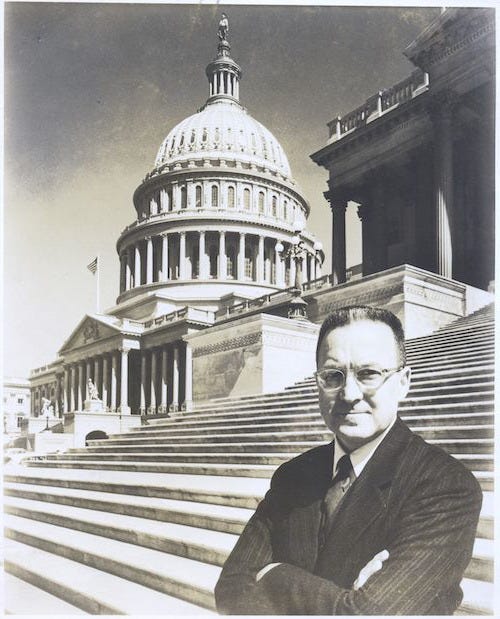
It was a blow to the staff, then, when Carroll left in 1955 to becomes news editor of The New York Times’ Washington bureau. He joined his old friend, James “Scotty” Reston, the bureau chief, and together they set out to build the finest team of journalists ever assembled. Carroll pirated Maggie Hunter from the Journal and Tom Wicker, an old Journal hand, from a newspaper in Nashville, TN. They joined seasoned veterans Russell Baker, Anthony Lewis, John Finney, E.W. Kenworthy.
By 1963, after executive shuffling in New York, it became clear that the bureau would lose its independence, and Carroll began to look around. He considered starting a paper in California or returning to his old one in Winston-Salem. He took the job as the publisher of the Journal and Sentinel because he knew that owner Gray would leave him alone and let him run the newspapers.
As publisher, Carroll considered himself a referee. His reporters and editors proceeded under their own steam, guided only by an occasional nudge. He met with editorial writers each morning but rarely talked at length. A word from him ended any debate.
He never shied away from controversial subjects. After some vigorous editorials supporting gun control, for instance, his dog was shot and killed near his home and one of his children was slipped a threatening note to take to his father.
Most of the editorials were written by others, but Carroll could be very convincing when he sat down at the typewriter. He penned an unusual front-page editorial in early 1964 when Gov. Terry Sanford was looking for a place for the state’s first special school for artists. Several cities were vying for what’s now the N.C. School of the Arts, but Carroll’s editorial tipped the balance in Winston-Salem’s favor. His signed editorial in 1968 questioning America’s continuing war in Vietnam generated more than 1,000 personal letters and was shown to Pres. Lyndon Johnson by Dean Acheson, a close friend of Carroll’s and a trusted adviser to the president. It crystallized the advice Johnson was getting, Acheson noted, and helped persuade him to seek peace negotiations.
To most staffers, Carroll was a presence, appearing from time to time at the mouth of the hallway to the executive offices to observe at an Olympian distance the controlled mayhem that is a newsroom. He was held in such high esteem that long after they retired newsroom staffers couldn’t bring themselves to call him by his first name. He was always “Mr. Carroll.”
And, then, he was gone, retiring in 1973. “He was a very quiet man who led by example,” Thompson said, “and quite often he got exactly what he wanted.”
What he wanted was the most-admired newspaper in North Carolina. That’s what he got, a newspaper that was stylishly written and expertly edited and won more awards each year than any other paper in the state, including a Pulitzer Prize in Public Service in 1971 for a series of stories about a proposal to strip mine in the state’s mountains.
Carroll died in 2002.
Love to read the history of why the Journal became such a respected publication.
An enjoyable read.